Complete RF PCB Design Tutorial: From Basics to Best Practices

We specialize in precision fabrication of radio frequency and microwave PCBs using premium substrates like Rogers, Taconic, and PTFE materials. Our advanced manufacturing processes ensure controlled impedance and superior signal integrity for wireless, aerospace, and high-frequency applications.Retry

As someone who has spent over a decade designing high-frequency circuits, I can tell you that RF PCB design is where theory meets reality in the most unforgiving way possible. A miscalculation of just a few mils in trace width can turn a perfectly functioning design into an expensive paperweight. This guide walks you through everything you need to know about RF PCB technology, from material selection to real-world applications.

What is an RF PCB?

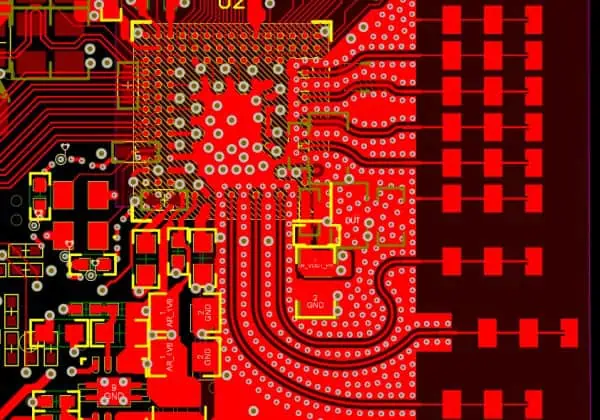
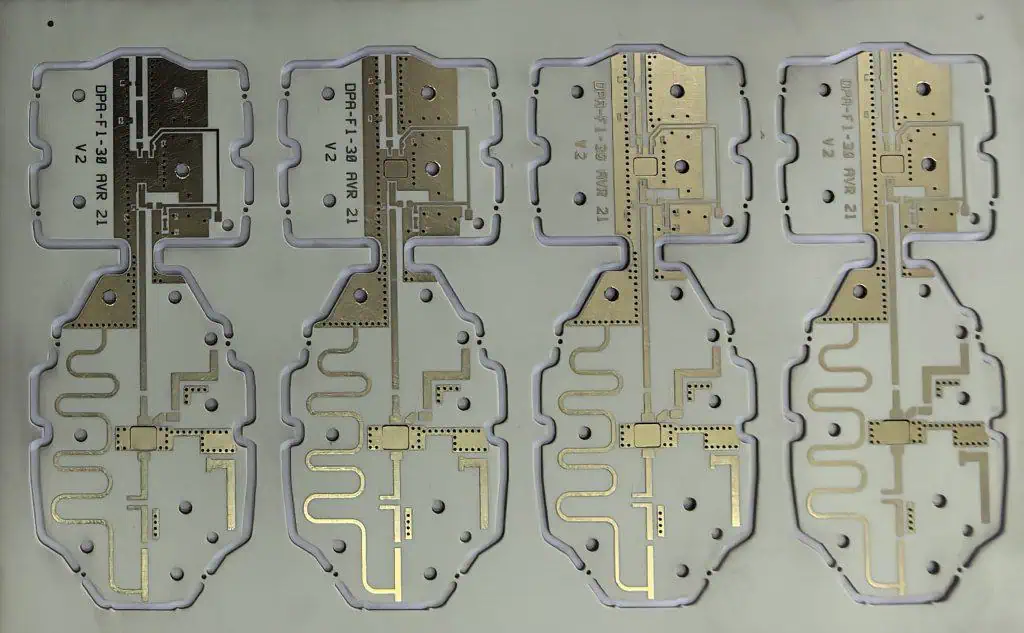
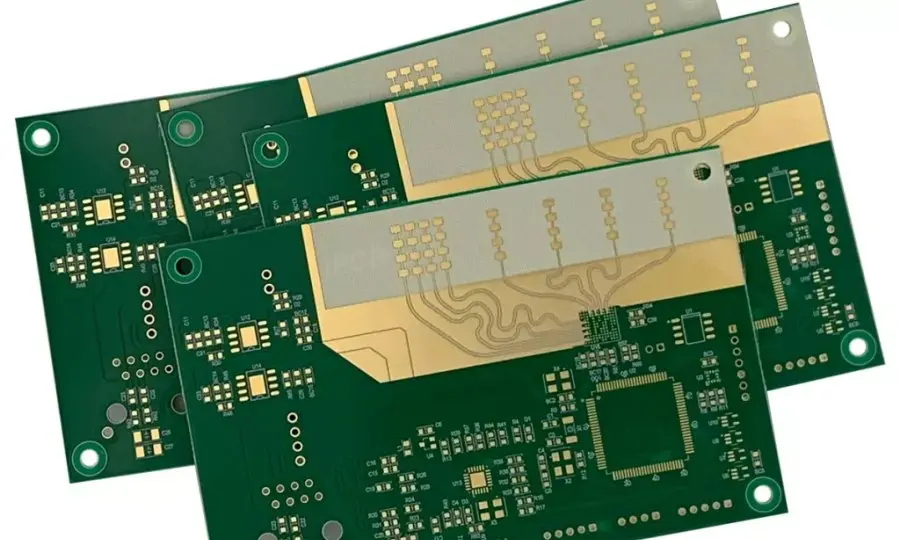
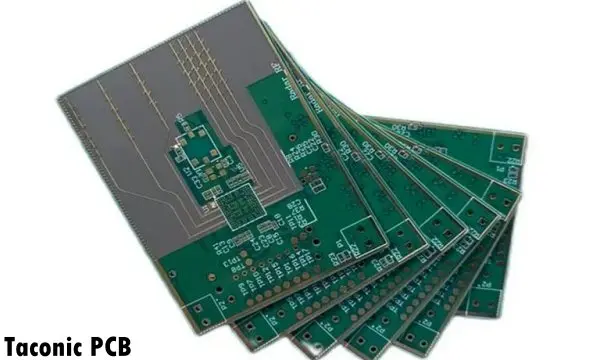
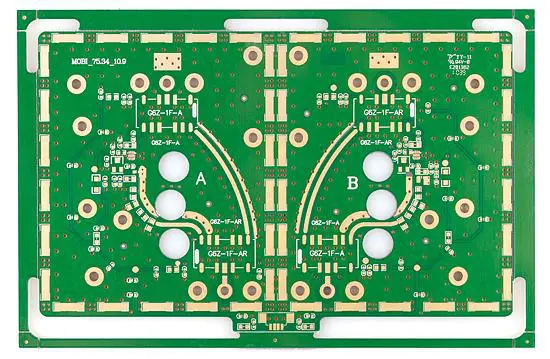
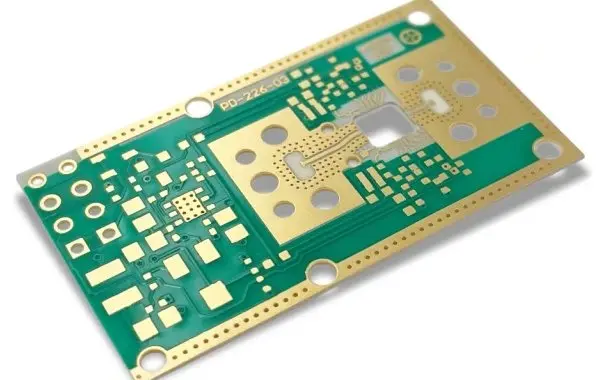
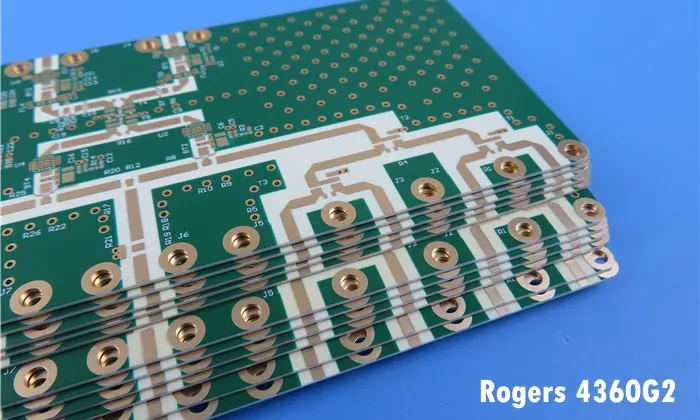
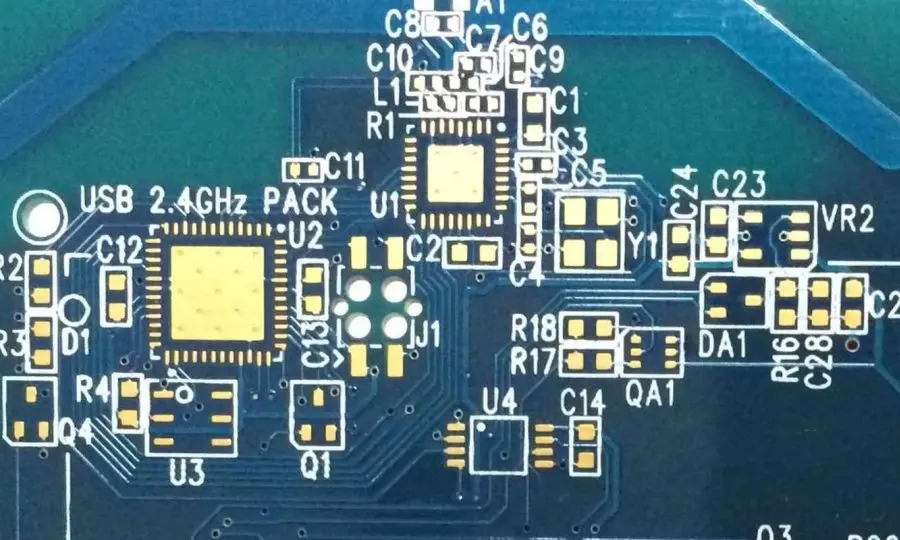
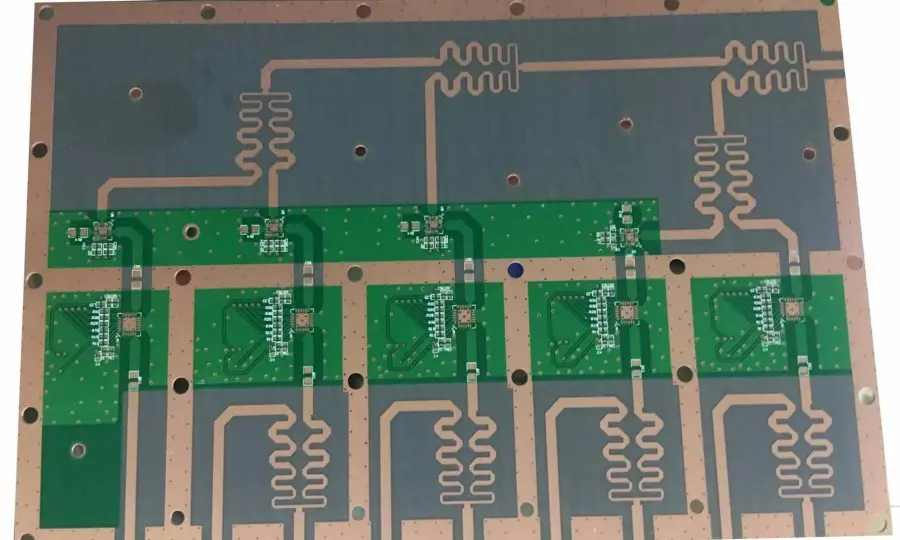
An RF PCB (Radio Frequency Printed Circuit Board) is a specialized circuit board engineered to handle high-frequency signals, typically operating above 100MHz and extending up to 300GHz. Unlike standard PCBs that simply need to provide electrical connectivity, RF PCB design requires careful attention to electromagnetic behavior, signal integrity, and transmission line effects.

At radio frequencies, PCB traces stop behaving like simple wires. They become transmission lines where the wavelength of signals approaches the physical dimensions of the circuit. This fundamental shift means that small variations in trace geometry, material properties, or manufacturing tolerances can significantly impact performance.

The industry generally categorizes RF PCBs into two main groups:

CategoryFrequency RangeTypical Applications
RF PCB100MHz – 2GHzWiFi, Bluetooth, GPS, cellular
Microwave PCB2GHz – 300GHzRadar, satellite, 5G mmWave

Why RF PCB Design Differs from Standard PCB Design

Standard digital PCB design focuses primarily on connectivity and signal timing. RF PCB design adds another layer of complexity that engineers must address to achieve reliable performance.

Key Challenges in RF PCB Design

Signal Integrity Issues: High-frequency signals are susceptible to reflections, attenuation, and phase distortion. These problems compound at higher frequencies where even minor impedance discontinuities cause measurable signal degradation.

Electromagnetic Interference (EMI): RF circuits can both generate and be affected by electromagnetic radiation. Without proper shielding and grounding strategies, interference between circuit sections becomes unavoidable.

Impedance Control: Maintaining consistent characteristic impedance throughout signal paths is non-negotiable. The standard values of 50Ω and 75Ω must be held to tight tolerances, often ±5% or better.

Thermal Management: High-frequency circuits, especially power amplifiers, generate significant heat. The dielectric properties of PCB materials can shift with temperature, creating a feedback loop that degrades performance.

Parasitic Effects: At RF frequencies, every component has parasitic capacitance and inductance. A simple via becomes a complex impedance element that must be modeled and accounted for in the design.

RF PCB Design Suite | RayPCB Engineering Tools

RF PCB Design Suite

Comprehensive engineering tools for high-frequency PCB design. Calculate impedance, compare materials, estimate costs, and optimize your RF designs.

85+
RF Materials
6
Calculators
77 GHz
Max Frequency
Impedance Calculator
Microstrip, Stripline, CPWG

Calculate transmission line impedance for various geometries with RF substrate materials.

📊
Materials Database
85+ RF Substrates

Compare Rogers, Taconic, Arlon, Isola, and more with detailed electrical properties.

💰
Cost Estimator
Instant Quotes

Get estimated manufacturing costs based on material, layers, and specifications.

Dk 3.48
Df 0.0037 @ 10GHz
Megtron 6
Dk 3.4
Df 0.002 @ 10GHz
Taconic RF-35
Dk 3.5
Df 0.0018 @ 10GHz
Isola Astra MT77
Dk 3.0
Df 0.0017 @ 10GHz
💡 Quick Tip

For frequencies above 10 GHz, consider materials with Df < 0.003 to minimize signal loss. Rogers RO3003 and Taconic TLY-5 are excellent choices for mmWave applications.

📊
RF Materials Database
Comprehensive substrate specifications
Material Manufacturer Dk @10GHz Df @10GHz Thickness (mm) CTE Z (ppm/°C) Tg (°C) Thermal K Max Freq Cost Index
🔬
Material Comparison
Select up to 4 materials
📋
Selection Guide
Quick reference by application
🛰️ Satellite/Aerospace

Rogers RT/duroid 5880, Taconic TLY-5, Arlon CLTE-XT

📱 5G/mmWave

Rogers RO3003, Taconic TLX-8, Isola Astra MT77

🚗 Automotive Radar

Rogers RO3003, RO4835, Taconic RF-35

📶 Wi-Fi/Bluetooth

Rogers RO4350B, Megtron 6, Isola I-Tera MT40

Microstrip Impedance Calculator
Surface trace on dielectric substrate
Ground Plane Dielectric (εr, H) W H W
mm
mm
mm
🎯
Target Impedance Synthesis
Calculate required trace width
Ω
mm
📐 Design Guidelines

• For 50Ω microstrip: W ≈ 2×H for εr ≈ 4
• Keep W/H between 0.5 and 4 for accurate models
• Consider via spacing for ground return path
• Edge coupling increases with narrower spacing

📚
Stack-Up Builder
Configure your PCB layers
📋
Stack-Up Preview
4-Layer RF/Digital Hybrid
Layer Type Material Thickness
L1Signal (RF)RO4350B35 μm Cu
-PrepregRO4450F0.1 mm
L2Ground-35 μm Cu
-CoreFR-41.0 mm
L3Power-35 μm Cu
-PrepregFR-4 PP0.2 mm
L4Signal-35 μm Cu
💡 RF Stack-Up Tips

• Place RF traces on outer layers adjacent to ground
• Use continuous ground plane under RF routing
• Consider thermal relief for RF components
• Match Dk between prepreg and core for hybrid stacks

📐
Common RF Stack-Ups
Industry-standard configurations
2-Layer Simple RF
RO4350B
Signal-Ground, 10-20 mil core. Best for simple RF circuits, filters, antennas.
4-Layer Hybrid
RO4350B + FR-4
RF/GND/PWR/Signal. Cost-effective mixed RF/digital design.
6-Layer High-Speed
Megtron 6
S/G/S/S/G/S. High-speed digital + RF with excellent signal integrity.
mmWave 4-Layer
RO3003 + RO4450F
Ultra-low loss for 24-77 GHz automotive radar applications.
5G Antenna Module
RT/duroid 5880
Multi-layer antenna array with integrated feed network.
SiP/Module Substrate
Isola Astra MT77
Fine-line capable, low-loss for System-in-Package applications.
💰
RF PCB Cost Estimator
Get instant manufacturing estimates
× mm
📊
Cost Breakdown
Estimated manufacturing cost
Base PCB (FR-4 equiv.) $--
Material Premium $--
Layer Count $--
Surface Finish $--
Impedance Control $--
Other Options $--
Estimated Total $--
Per Board
$--
Per sq. inch
$--
⚠️ Disclaimer

This is an estimate only. Actual costs vary by manufacturer, lead time, and specific requirements. Contact RayPCB for accurate quotes.

📋
Material Cost Index
Relative pricing comparison
Budget
1× - 1.5×
FR-4, High-Tg FR-4
Mid-Range
2× - 3.5×
Megtron 4/6, Nelco N4000
Premium RF
4× - 6×
RO4350B, RO4003C, RO3003
Ultra Low-Loss
6× - 10×
RT/duroid 5880, TLY-5
📖
RF Design Formulas
Essential equations
Wavelength

λ₀ = c / f = 299.792 / f(GHz) mm
λg = λ₀ / √εeff

Skin Depth

δ = √(ρ / πfμ)
For copper: δ ≈ 66/√f(MHz) μm

Dielectric Loss

αd = 27.3 × (εr/εeff) × (εeff-1)/(εr-1) × (tan δ/λ₀) dB/length

Propagation Delay

tpd = √εeff / c ≈ 3.33√εeff ps/mm

Via Inductance (Approx)

L ≈ 5.08h[ln(4h/d) + 1] nH
h = via height (in), d = via diameter (in)

🔧
Design Guidelines
Best practices for RF PCB
📐 Trace Width Rules

• 50Ω microstrip: W ≈ 1.8-2× substrate height (εr≈4)
• Keep W/H ratio between 0.5 and 4
• Match trace widths at transitions

🔗 Via Design

• Ground via spacing < λ/10
• Via stub length < λ/20 for mmWave
• Use back-drilling for high-frequency
• Multiple vias reduce inductance

🌐 Grounding

• Solid ground plane under RF traces
• Avoid splits/slots under RF routing
• Via stitch ground around RF sections
• Star ground for mixed-signal

📏 Layout Tips

• Keep RF traces short and direct
• 45° or curved bends, no 90° corners
• Maintain consistent trace width
• Isolate RF from digital/power

📊
Unit Conversion Reference
Common conversions for RF design

Length

1 mil=0.0254 mm
1 mm=39.37 mil
1 inch=25.4 mm
1 μm=0.0394 mil

Copper Weight

0.5 oz=17.5 μm
1 oz=35 μm
2 oz=70 μm
3 oz=105 μm

Frequency

1 GHz=1000 MHz
λ @ 1 GHz=300 mm
λ @ 10 GHz=30 mm
λ @ 77 GHz=3.9 mm

© 2024 RayPCB Engineering Tools | RF PCB Design Suite v2.0

For accurate quotes and DFM support, contact our engineering team.

RF PCB Design Suite | RayPCB Engineering Tools

RF PCB Design Suite

Comprehensive engineering tools for high-frequency PCB design. Calculate impedance, compare materials, estimate costs, and optimize your RF designs.

85+
RF Materials
6
Calculators
77 GHz
Max Frequency
Impedance Calculator
Microstrip, Stripline, CPWG

Calculate transmission line impedance for various geometries with RF substrate materials.

📊
Materials Database
85+ RF Substrates

Compare Rogers, Taconic, Arlon, Isola, and more with detailed electrical properties.

💰
Cost Estimator
Instant Quotes

Get estimated manufacturing costs based on material, layers, and specifications.

Rogers 4350B
Dk 3.48
Df 0.0037 @ 10GHz
Megtron 6
Dk 3.4
Df 0.002 @ 10GHz
Taconic RF-35
Dk 3.5
Df 0.0018 @ 10GHz
Isola Astra MT77
Dk 3.0
Df 0.0017 @ 10GHz
💡 Quick Tip

For frequencies above 10 GHz, consider materials with Df < 0.003 to minimize signal loss. Rogers RO3003 and Taconic TLY-5 are excellent choices for mmWave applications.

📊
RF Materials Database
Comprehensive substrate specifications
Material Manufacturer Dk @10GHz Df @10GHz Thickness (mm) CTE Z (ppm/°C) Tg (°C) Thermal K Max Freq Cost Index
🔬
Material Comparison
Select up to 4 materials
📋
Selection Guide
Quick reference by application
🛰️ Satellite/Aerospace

Rogers RT/duroid 5880, Taconic TLY-5, Arlon CLTE-XT

📱 5G/mmWave

Rogers RO3003, Taconic TLX-8, Isola Astra MT77

🚗 Automotive Radar

Rogers RO3003, RO4835, Taconic RF-35

📶 Wi-Fi/Bluetooth

Rogers RO4350B, Megtron 6, Isola I-Tera MT40

Microstrip Impedance Calculator
Surface trace on dielectric substrate
Ground Plane Dielectric (εr, H) W H W
mm
mm
mm
🎯
Target Impedance Synthesis
Calculate required trace width
Ω
mm
📐 Design Guidelines

• For 50Ω microstrip: W ≈ 2×H for εr ≈ 4
• Keep W/H between 0.5 and 4 for accurate models
• Consider via spacing for ground return path
• Edge coupling increases with narrower spacing

📚
Stack-Up Builder
Configure your PCB layers
📋
Stack-Up Preview
4-Layer RF/Digital Hybrid
Layer Type Material Thickness
L1Signal (RF)RO4350B35 μm Cu
-PrepregRO4450F0.1 mm
L2Ground-35 μm Cu
-CoreFR-41.0 mm
L3Power-35 μm Cu
-PrepregFR-4 PP0.2 mm
L4Signal-35 μm Cu
💡 RF Stack-Up Tips

• Place RF traces on outer layers adjacent to ground
• Use continuous ground plane under RF routing
• Consider thermal relief for RF components
• Match Dk between prepreg and core for hybrid stacks

📐
Common RF Stack-Ups
Industry-standard configurations
2-Layer Simple RF
RO4350B
Signal-Ground, 10-20 mil core. Best for simple RF circuits, filters, antennas.
4-Layer Hybrid
RO4350B + FR-4
RF/GND/PWR/Signal. Cost-effective mixed RF/digital design.
6-Layer High-Speed
Megtron 6
S/G/S/S/G/S. High-speed digital + RF with excellent signal integrity.
mmWave 4-Layer
RO3003 + RO4450F
Ultra-low loss for 24-77 GHz automotive radar applications.
5G Antenna Module
RT/duroid 5880
Multi-layer antenna array with integrated feed network.
SiP/Module Substrate
Isola Astra MT77
Fine-line capable, low-loss for System-in-Package applications.
💰
RF PCB Cost Estimator
Get instant manufacturing estimates
× mm
📊
Cost Breakdown
Estimated manufacturing cost
Base PCB (FR-4 equiv.) $--
Material Premium $--
Layer Count $--
Surface Finish $--
Impedance Control $--
Other Options $--
Estimated Total $--
Per Board
$--
Per sq. inch
$--
⚠️ Disclaimer

This is an estimate only. Actual costs vary by manufacturer, lead time, and specific requirements. Contact RayPCB for accurate quotes.

📋
Material Cost Index
Relative pricing comparison
Budget
1× - 1.5×
FR-4, High-Tg FR-4
Mid-Range
2× - 3.5×
Megtron 4/6, Nelco N4000
Premium RF
4× - 6×
RO4350B, RO4003C, RO3003
Ultra Low-Loss
6× - 10×
RT/duroid 5880, TLY-5
📖
RF Design Formulas
Essential equations
Wavelength

λ₀ = c / f = 299.792 / f(GHz) mm
λg = λ₀ / √εeff

Skin Depth

δ = √(ρ / πfμ)
For copper: δ ≈ 66/√f(MHz) μm

Dielectric Loss

αd = 27.3 × (εr/εeff) × (εeff-1)/(εr-1) × (tan δ/λ₀) dB/length

Propagation Delay

tpd = √εeff / c ≈ 3.33√εeff ps/mm

Via Inductance (Approx)

L ≈ 5.08h[ln(4h/d) + 1] nH
h = via height (in), d = via diameter (in)

🔧
Design Guidelines
Best practices for RF PCB
📐 Trace Width Rules

• 50Ω microstrip: W ≈ 1.8-2× substrate height (εr≈4)
• Keep W/H ratio between 0.5 and 4
• Match trace widths at transitions

🔗 Via Design

• Ground via spacing < λ/10
• Via stub length < λ/20 for mmWave
• Use back-drilling for high-frequency
• Multiple vias reduce inductance

🌐 Grounding

• Solid ground plane under RF traces
• Avoid splits/slots under RF routing
• Via stitch ground around RF sections
• Star ground for mixed-signal

📏 Layout Tips

• Keep RF traces short and direct
• 45° or curved bends, no 90° corners
• Maintain consistent trace width
• Isolate RF from digital/power

📊
Unit Conversion Reference
Common conversions for RF design

Length

1 mil=0.0254 mm
1 mm=39.37 mil
1 inch=25.4 mm
1 μm=0.0394 mil

Copper Weight

0.5 oz=17.5 μm
1 oz=35 μm
2 oz=70 μm
3 oz=105 μm

Frequency

1 GHz=1000 MHz
λ @ 1 GHz=300 mm
λ @ 10 GHz=30 mm
λ @ 77 GHz=3.9 mm

© 2024 RayPCB Engineering Tools | RF PCB Design Suite v2.0

For accurate quotes and DFM support, contact our engineering team.

Types of RF PCBs

Understanding the different RF PCB configurations helps engineers select the right approach for their specific application requirements.

Rigid RF PCBs

These boards use solid substrate materials and provide excellent dimensional stability. Most multilayer RF designs fall into this category, with substrate materials sandwiched between copper traces in multiple layers. Rigid RF PCBs offer superior performance for signal integrity and noise reduction but lack mechanical flexibility.

Flexible RF PCBs

Flexible RF PCBs utilize polyimide or polyester substrates that can bend and conform to irregular spaces. They find applications in wearable devices, aerospace systems, and anywhere mechanical flexibility is required without sacrificing high-frequency performance.

Rigid-Flex RF PCBs

Combining rigid and flexible sections in a single board, rigid-flex RF PCBs offer design complexity while maintaining signal integrity. This configuration reduces the need for connectors between board sections, eliminating potential impedance discontinuities.

High-Frequency RF PCBs

Specifically engineered for signals in the GHz range, these boards implement substrates with extremely low dielectric constants and loss tangents. They minimize signal attenuation and maintain integrity at frequencies that would destroy performance on standard materials.

RF Antenna PCBs

In these designs, the PCB itself serves as the antenna structure. Engineers optimize the board layout for gain, radiation pattern, and impedance matching rather than just signal routing. Applications range from wireless communication devices to IoT sensors and RFID systems.

RF PCB Materials: The Foundation of Performance

Material selection fundamentally impacts RF PCB performance. While FR-4 remains the standard for most PCB applications, RF designs often require specialized materials with superior electrical properties.

FR-4 Limitations at RF Frequencies

FR-4 works acceptably for circuits operating below about 1GHz with moderate performance requirements. However, its limitations become problematic at higher frequencies:

  • Dielectric constant (Dk) ranges from 4.2 to 4.8, which is higher than ideal for RF circuits
  • Loss tangent (Df) of 0.02 causes significant signal attenuation above a few GHz
  • Dk varies with frequency and temperature, creating impedance instability
  • Moisture absorption affects electrical properties over time

High-Performance RF PCB Materials Comparison

MaterialDk RangeDf (Loss Tangent)Max FrequencyBest For
FR-44.2-4.80.02~1GHzLow-cost, low-frequency
Rogers RO4003C3.380.002710GHz+Cost-effective RF
Rogers RO4350B3.480.003710GHz+5G, automotive radar
Rogers RT/duroid 58802.20.000977GHz+Aerospace, mmWave
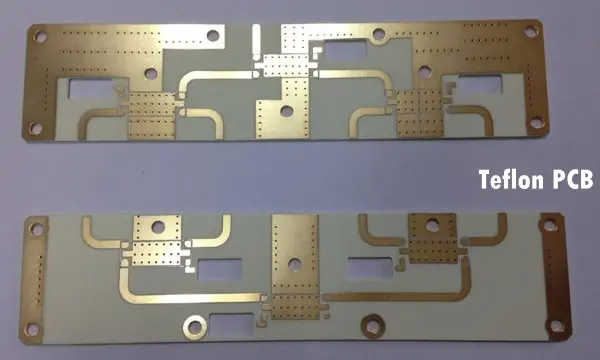
PTFE/Teflon2.1-2.550.00140GHz+Military, satellite
Ceramic-filled6.0-10.20.00220GHz+Miniaturized designs

Rogers Materials: The Industry Standard

Rogers Corporation has become synonymous with high-frequency PCB materials. Their product lines address different performance and cost requirements:

RO4000 Series: These hydrocarbon/ceramic laminates process like standard FR-4 but deliver RF performance approaching PTFE materials. Rogers RO4350B, with Dk of 3.48 and Df of 0.0037, has become the go-to material for 5G base stations and automotive radar systems.

RO3000 Series: Designed specifically for high-frequency microwave circuits and antennas, this series features stable Dk values from 3.0 to 6.15 with extremely low loss factors (Df ~0.0013-0.003).

RT/duroid Series: For the most demanding applications, RT/duroid 5880 offers Dk as low as 2.2 with loss tangent of just 0.0009. This material maintains consistent performance up to 77GHz and beyond, making it essential for mmWave radar and satellite communications.

Material Selection Guidelines

Choosing the right material requires balancing performance requirements against cost and manufacturability:

  1. Frequency below 1GHz: Standard FR-4 may suffice for cost-sensitive applications
  2. 1-10GHz range: Rogers RO4003C or RO4350B provide excellent performance at reasonable cost
  3. 10-40GHz: PTFE-based materials like RT/duroid become necessary
  4. Above 40GHz: Specialized low-loss PTFE or ceramic materials are required
  5. Hybrid stackups: Combine Rogers materials on outer RF layers with FR-4 for digital/power layers to optimize cost

RF PCB Design Guidelines: Best Practices That Work

Successful RF PCB design requires systematic attention to stackup configuration, trace routing, grounding, and component placement. These guidelines represent lessons learned from countless designs.

Stackup Design Principles

The vertical arrangement of signals and planes directly influences RF performance. Key considerations include:

Signal Layer Placement: Route RF traces on the top layer with an immediate ground plane below. This configuration ensures the shortest return path and optimal impedance control.

Ground Plane Continuity: Avoid splits or gaps in ground planes under RF traces. Discontinuities create impedance variations and increase radiation.

Layer Symmetry: Symmetric stackups minimize warpage and provide consistent impedance across the board.

Transmission Line Design

RF traces function as transmission lines that must maintain controlled impedance. The three primary structures used in RF PCB design are:

Microstrip: Signal trace on an outer layer over a ground plane. Simple to implement but susceptible to radiation at higher frequencies. Typical for frequencies below 10GHz.

Stripline: Signal trace sandwiched between two ground planes on inner layers. Provides superior isolation but requires more layers and adds complexity.

Coplanar Waveguide (CPW): Signal trace flanked by ground pour on the same layer, often with a ground plane below (grounded coplanar waveguide). Offers excellent isolation and easier impedance control at microwave frequencies.

Impedance Control Requirements

Impedance ValuePrimary ApplicationsTolerance
50ΩMost RF systems±5% to ±10%
75ΩVideo, cable systems±5% to ±10%
100Ω differentialHigh-speed digital±10%

The 50Ω impedance value dominates RF design because it represents an optimal balance between power handling capability and signal loss. Selecting components with 50Ω characteristic impedance simplifies matching and allows each trace to be assigned the correct width based on material properties.

Trace Width Calculation

Trace width for a given impedance depends on:

  • Dielectric constant (Dk) of the substrate
  • Dielectric thickness (H) between trace and reference plane
  • Copper thickness (T)
  • Target impedance (Z0)

For a 50Ω microstrip on Rogers RO4350B (Dk=3.48) with 10mil substrate and 1oz copper, typical trace width is approximately 22 mils. Always verify with impedance calculators or electromagnetic simulation tools.

Typical Trace Widths for 50Ω Impedance

MaterialDkSubstrate ThicknessApprox. Trace Width
FR-44.510 mil (0.254mm)18 mil (0.46mm)
Rogers RO4003C3.3810 mil (0.254mm)24 mil (0.61mm)
Rogers RO4350B3.4810 mil (0.254mm)23 mil (0.58mm)
Rogers RO4350B3.4820 mil (0.508mm)44 mil (1.1mm)
RT/duroid 58802.210 mil (0.254mm)31 mil (0.79mm)

These values are approximate starting points. Final trace widths must account for copper thickness, manufacturing tolerances, and the specific trace structure (microstrip vs. stripline vs. coplanar waveguide).

Via Design for RF Performance

Vias represent one of the most significant sources of impedance discontinuity in RF PCBs. At microwave frequencies, a simple via transition can introduce several dB of loss and significant reflection.

Via Parameters to Control:

  • Via diameter: Smaller vias have lower inductance but increased resistance
  • Pad size: Larger pads add capacitance; minimize while maintaining manufacturability
  • Anti-pad size: Affects capacitive coupling to adjacent planes
  • Via barrel length: Longer barrels add inductance; use back-drilling when necessary

Via Stub Elimination: In multilayer boards, via stubs create quarter-wave resonances that cause notches in frequency response. For signals above 5GHz, consider back-drilling to remove unused via barrel sections. The resonant frequency of a via stub is approximately:

f(resonance) = c / (4 × L × √εr)

Where L is the stub length and εr is the effective dielectric constant.

RF Trace Routing Best Practices

Routing RF traces requires attention to details that may seem minor but significantly impact performance:

Trace Bends: Avoid 90-degree corners, which create impedance discontinuities and radiate. Use 45-degree miters or curved traces with a bend radius of at least 3× the trace width.

Trace Length Matching: For differential pairs and phased array feeds, match trace lengths to within 1-2 mils depending on the operating frequency. At 77GHz (automotive radar), a 1mm length difference creates approximately 12 degrees of phase error.

Reference Plane Transitions: When changing reference planes (e.g., moving from layer 1 to layer 3), use stitching vias to provide a low-inductance return path near the signal via.

Keepout Zones: Establish keepout regions around RF traces to prevent coupling from adjacent signals. The keepout distance should be at least 3× the trace width or 3× the substrate height, whichever is greater.

Grounding Strategies

Proper grounding separates successful RF designs from problematic ones:

Multiple Via Connections: Use multiple ground vias around RF components to provide low-inductance return paths. Via stitching along coplanar waveguide ground pours maintains isolation.

Avoid Ground Plane Gaps: Never route high-speed signals across splits in ground planes. The return current must take a longer path, increasing inductance and creating radiation.

Star Grounding for Mixed Signals: In boards combining RF and digital circuits, use separate ground regions connected at a single point to prevent digital noise from coupling into sensitive RF sections.

Component Placement Guidelines

Minimize Trace Lengths: Keep RF signal paths as short as possible. Every millimeter of trace adds loss and potential for impedance discontinuities.

Separate RF from Digital: Maintain at least 10mm separation between RF and digital circuit sections. Use 20mm or more when possible.

Orient Components Consistently: Align similar components to facilitate consistent routing and improve manufacturability.

Position Passives Carefully: Place decoupling capacitors and matching network components as close to their associated ICs as possible. Long traces to passives add parasitic inductance that degrades performance.

RF PCB Manufacturing Process

Manufacturing RF PCBs requires tighter process control than standard fabrication. Understanding these requirements helps designers create manufacturable designs and select capable suppliers.

Critical Manufacturing Parameters

Dielectric Thickness Control: Variations in dielectric thickness directly affect impedance. RF PCBs typically require ±10% or tighter control on dielectric thickness. For a 10mil substrate at 50Ω impedance, a 1mil thickness variation can shift impedance by 3-5Ω.

Copper Roughness: At high frequencies, current flows in a thin skin on the conductor surface. The skin depth decreases with frequency—at 10GHz, it’s only about 0.66 microns in copper. Rougher copper increases effective path length and resistance. Low-profile copper foils (1.0 μm Ra or less) can reduce loss by 10-20% compared to standard electrodeposited copper above 10GHz.

Copper Foil Types for RF Applications:

Foil TypeSurface Roughness (Ra)Best For
Standard ED2.0-3.0 μmBelow 3GHz
Reverse Treated (RTF)1.5-2.0 μm3-10GHz
Very Low Profile (VLP)1.0-1.5 μm10-40GHz
Ultra-Low Profile0.5-1.0 μmAbove 40GHz

Registration Accuracy: Precise layer-to-layer alignment ensures transmission line geometry matches the design. Misregistration creates impedance variations and can destroy RF performance. Critical RF designs may require ±2mil or better registration compared to ±4mil for standard boards.

Plating Uniformity: Via plating thickness must be consistent to maintain impedance through layer transitions. Variations in plating can create impedance bumps that cause reflections at high frequencies.

PTFE and Specialty Material Processing

PTFE-based materials like Rogers RT/duroid present unique manufacturing challenges:

Drilling: PTFE is softer than FR-4 and requires adjusted drilling parameters to prevent smearing and ensure clean hole walls. Entry and exit materials help maintain hole quality.

Plasma Etch: PTFE materials typically require plasma treatment to remove smear from hole walls before plating. Without proper desmear, plating adhesion suffers.

Lamination: PTFE materials have different thermal expansion characteristics than FR-4. Hybrid stackups require careful lamination cycle design to prevent delamination.

Hybrid Stackup Manufacturing

Many RF designs use hybrid stackups combining high-performance RF materials on outer layers with cost-effective FR-4 for inner layers. This approach requires:

  • Careful selection of prepreg materials compatible with both substrates
  • Optimized lamination profiles accounting for different material behaviors
  • Attention to CTE matching to prevent warpage and internal stress

Testing and Verification

RF PCB manufacturers typically perform these verification steps:

TestPurposeTypical Requirement
TDR (Time Domain Reflectometry)Impedance verification±5% of target
Network AnalyzerS-parameter measurementApplication-specific
Flying ProbeContinuity/isolationPer IPC standards
X-ray InspectionVia/plating qualityPer IPC-6012
Microsection AnalysisLayer thickness verificationPer IPC-6012 Class 3
Dielectric Constant MeasurementMaterial verification±2% of specified Dk

Design for Manufacturability (DFM) Considerations

Working with your RF PCB manufacturer early in the design process prevents costly iterations:

Standard Layer Counts: Stick to common layer counts (2, 4, 6, 8 layers) when possible. Odd layer counts create manufacturing complexity without significant benefit.

Panel Utilization: Design board dimensions that fit efficiently on standard panel sizes to minimize waste and cost.

Impedance Test Coupons: Include test coupons on the panel for impedance verification without destructive testing of production boards.

Documentation: Provide complete stackup requirements, impedance specifications, and material callouts. Ambiguous documentation leads to incorrect assumptions and failed builds.

RF PCB Applications: Where High-Frequency Boards Make the Difference

RF PCBs enable the wireless technologies that define modern life. Understanding application requirements helps engineers select appropriate design approaches and materials.

5G and Telecommunications Infrastructure

5G networks operate at frequencies from sub-6GHz to millimeter-wave bands (24-100GHz). This creates unprecedented demands on RF PCB technology:

Massive MIMO Antenna Arrays: 5G base stations use arrays of 64 or more antenna elements, each requiring phase-matched RF paths. PCB materials must maintain consistent Dk to ensure proper beamforming.

mmWave Small Cells: Operating at 28GHz and above, mmWave systems demand materials with extremely low loss. Rogers RO4835 and similar materials dominate these applications.

RF Front-End Modules: Power amplifiers, filters, and switches for 5G handsets require compact RF PCBs with excellent thermal management.

Automotive Radar Systems

Modern vehicles incorporate multiple radar systems for safety and autonomous driving functions:

24GHz Short-Range Radar: Used for blind spot detection and parking assistance. These systems integrate antenna structures directly into the PCB.

77GHz Long-Range Radar: Forward-facing radar for adaptive cruise control and collision avoidance requires extremely tight tolerances on antenna dimensions—down to ±0.015mm—to ensure proper beamforming and signal accuracy.

Aerospace and Defense

Military and aerospace systems demand the highest reliability under extreme conditions:

Phased Array Radar: Used in aircraft and ships, these systems require hundreds of RF channels with matched phase characteristics. PCB material stability across temperature extremes is critical.

Satellite Communications: Spacecraft electronics must withstand radiation, vacuum, and extreme temperature cycling while maintaining performance over mission lifetimes of 15+ years.

Electronic Warfare: Systems that detect, jam, or spoof enemy signals require wideband RF performance with fast frequency agility.

Medical Devices

Healthcare applications increasingly rely on RF technology:

Medical Imaging: MRI machines, CT scanners, and ultrasound equipment use RF circuits for signal generation and processing. These systems require extremely low noise figures and precise phase control.

Wireless Patient Monitoring: Continuous monitoring systems transmit patient data using low-power RF links. Reliability and battery life are paramount, requiring optimized RF PCB designs that minimize power consumption.

Implantable Devices: Pacemakers and neurostimulators use RF communication for programming and monitoring. These devices must operate reliably for years while meeting strict biocompatibility and electromagnetic emission standards.

Therapeutic Equipment: RF ablation systems for tumor treatment and electrosurgical devices require high-power RF PCBs with excellent thermal management.

IoT and Wireless Connectivity

The Internet of Things drives demand for compact, low-cost RF PCBs:

WiFi and Bluetooth: Consumer devices require cost-effective RF design that meets performance specifications without over-engineering. The challenge is achieving adequate range and throughput while minimizing board area and component count.

LPWAN Technologies: LoRa, Sigfox, and NB-IoT devices need optimized RF performance for maximum range with minimal power consumption. These applications often use simple antenna structures integrated into the PCB.

RFID Systems: Asset tracking and access control systems integrate RF PCB technology with antenna structures for compact, reliable performance. Both passive (reader-powered) and active (battery-powered) RFID tags rely on careful RF design.

Smart Home Devices: Connected thermostats, locks, cameras, and sensors use various RF protocols. Multi-protocol support (WiFi + Bluetooth + Zigbee) creates additional design complexity.

Emerging Applications

Several growing application areas are driving RF PCB innovation:

6G Research: Next-generation wireless systems may operate at frequencies above 100GHz, pushing material and manufacturing capabilities to new limits.

Autonomous Vehicles: Beyond radar, future autonomous systems will incorporate V2X (vehicle-to-everything) communication requiring reliable RF performance in challenging automotive environments.

Space Internet Constellations: Low Earth orbit satellite systems for global internet coverage require thousands of RF-intensive terminals driving volume production of high-frequency PCBs.

Useful Resources for RF PCB Design

Having the right tools and references accelerates RF PCB development and reduces costly iterations.

Impedance Calculators

ToolFeaturesAccess
Sierra Circuits Impedance Calculator2D field solver, multiple geometriesprotoexpress.com/tools/pcb-impedance-calculator
Saturn PCB ToolkitComprehensive design calculationssaturnpcb.com
JLCPCB Impedance CalculatorStack-up recommendations includedjlcpcb.com/pcb-impedance-calculator
Rogers MWI CalculatorOptimized for Rogers materialsrogerscorp.com
Analog Devices RF CalculatorImpedance matching networksanalog.com/resources/interactive-design-tools
PCBWay Impedance Calculator

Multiple trace structures

pcbway.com/pcb_prototype/impedance_calculator.html

PCB Design Software with RF Capabilities

Altium Designer: Integrated field solver, impedance-controlled routing, and comprehensive RF design tools. The built-in Simberian field solver provides accurate propagation delay and impedance calculations.

Cadence Allegro/OrCAD: Industry-standard for complex RF/mixed-signal designs with powerful simulation integration. Supports advanced constraint management for impedance-controlled routing.

Keysight ADS (Advanced Design System): Advanced electromagnetic simulation for RF circuit and system design. Industry-leading for RF front-end and MMIC design.

Ansys HFSS: 3D electromagnetic simulation for antenna and high-frequency structure design. Essential for complex structures where 2D analysis is insufficient.

CST Studio Suite: Full-wave 3D electromagnetic simulation with strong antenna and EMC analysis capabilities.

Material Datasheets and Selection Guides

  • Rogers Corporation: rogerscorp.com — Complete datasheets for all RF laminates plus design resources
  • Taconic: taconicpcb.com — High-frequency laminate specifications and application notes
  • Isola Group: isola-group.com — Low-loss material data and stackup recommendations
  • AGC/Nelco: agc-chemicals.com — Specialty RF materials for demanding applications
  • DuPont: dupont.com — Flexible circuit materials including RF-capable polyimides

Technical Documentation and Learning Resources

ResourceContent TypeURL
Microwaves101RF engineering tutorialsmicrowaves101.com
RF CafeCalculators and reference datarfcafe.com
EDN RF/MicrowaveIndustry news and technical articlesedn.com
IEEE MTT-STechnical papers and standardsmtt.org
Altium RF ResourcesDesign guides and webinarsresources.altium.com/rf-pcb-design

Industry Standards

StandardScope
IPC-6012Qualification and performance specification for rigid PCBs
IPC-6018High-frequency PCB qualification and performance
IPC-2141AControlled impedance design guidelines
IPC-A-600Acceptability of printed boards
IPC-2221Generic standard for PCB design
IPC-7351Land pattern design requirements

Common RF PCB Design Mistakes and How to Avoid Them

After reviewing countless RF designs, certain mistakes appear repeatedly. Avoiding these common pitfalls saves time and money.

Material Selection Errors

Mistake: Using FR-4 for circuits operating above 2-3GHz to save cost. Solution: Calculate the actual loss impact and compare against performance requirements. The material cost savings often disappear in failed prototypes and redesigns.

Impedance Mismatches

Mistake: Neglecting impedance control on “short” traces. Solution: At GHz frequencies, even traces a few millimeters long can cause significant reflections. Control impedance on all RF paths regardless of length.

Poor Grounding

Mistake: Routing RF signals across ground plane splits or using inadequate via stitching. Solution: Maintain continuous ground planes under all RF traces and use via stitching at intervals of λ/10 or less along coplanar waveguide structures.

Insufficient Separation

Mistake: Placing digital circuits adjacent to sensitive RF sections. Solution: Use physical separation, shielding, and filtered power supplies to prevent coupling between circuit sections.

Via Stub Effects

Mistake: Ignoring via stub length in multilayer boards. Solution: Use back-drilling to remove via stubs or design transitions to minimize stub length. Stubs create resonances that degrade high-frequency performance.

FAQs About RF PCB Design

What frequency requires RF PCB design techniques?

Most experts recommend treating any design operating above 100MHz as requiring RF design consideration. However, the specific frequency threshold depends on trace lengths, performance requirements, and acceptable loss levels. Circuits at a few hundred MHz may need controlled impedance but not specialized materials, while designs above 1GHz typically require dedicated RF materials and design techniques.

Can I use FR-4 for RF PCB applications?

FR-4 can work for RF applications below approximately 1-2GHz if loss budgets are generous and tight impedance control is not critical. For WiFi at 2.4GHz, FR-4 designs can succeed with careful attention to trace routing. Above 5GHz, FR-4 limitations become severe enough that specialized materials are almost always required for acceptable performance.

How much do RF PCB materials cost compared to standard FR-4?

Rogers and similar high-frequency materials typically cost 2-5 times more than FR-4 per square foot. However, the total board cost depends on complexity, layer count, and volume. A 4-layer Rogers board might cost $200-800 per square meter for raw material compared to $50-100 for FR-4. Hybrid stackups using Rogers only on RF signal layers can reduce costs by 30-50% while maintaining RF performance.

What is the most important factor in RF PCB design?

While many factors matter, material selection and impedance control stand out as the most critical. Choosing the wrong material creates problems that no amount of careful layout can overcome. Impedance discontinuities cause reflections that degrade signal integrity regardless of other design excellence. Start with appropriate materials and rigorous impedance control, then address other factors systematically.

How do I find a qualified RF PCB manufacturer?

Look for manufacturers with specific RF/microwave experience, appropriate certifications (ISO 9001, IPC-6018 capability), and familiarity with your chosen materials. Request impedance test data from previous builds and ask about their process controls for dielectric thickness and copper roughness. A manufacturer’s willingness to discuss these technical details indicates their RF capability level.

Conclusion: Building Better RF PCBs

RF PCB design combines electrical engineering fundamentals with practical manufacturing knowledge and hard-won experience. Success requires understanding how high-frequency signals interact with PCB materials and structures, then applying that knowledge through systematic design practices.

The key principles remain consistent regardless of frequency or application:

  • Select materials appropriate for your frequency range and performance requirements
  • Control impedance throughout all RF signal paths
  • Maintain proper grounding with continuous reference planes
  • Separate RF and digital circuits to prevent coupling
  • Work with manufacturers who understand RF requirements

As wireless technologies continue advancing toward higher frequencies and tighter performance specifications, RF PCB design expertise becomes increasingly valuable. Whether designing 5G infrastructure, automotive radar, or IoT devices, the fundamentals covered in this guide provide the foundation for successful high-frequency circuit boards.

The techniques and materials available today enable RF performance that would have been impossible just a decade ago. By applying these principles systematically, engineers can create RF PCBs that meet the demanding requirements of modern wireless systems while maintaining practical manufacturability and reasonable cost.