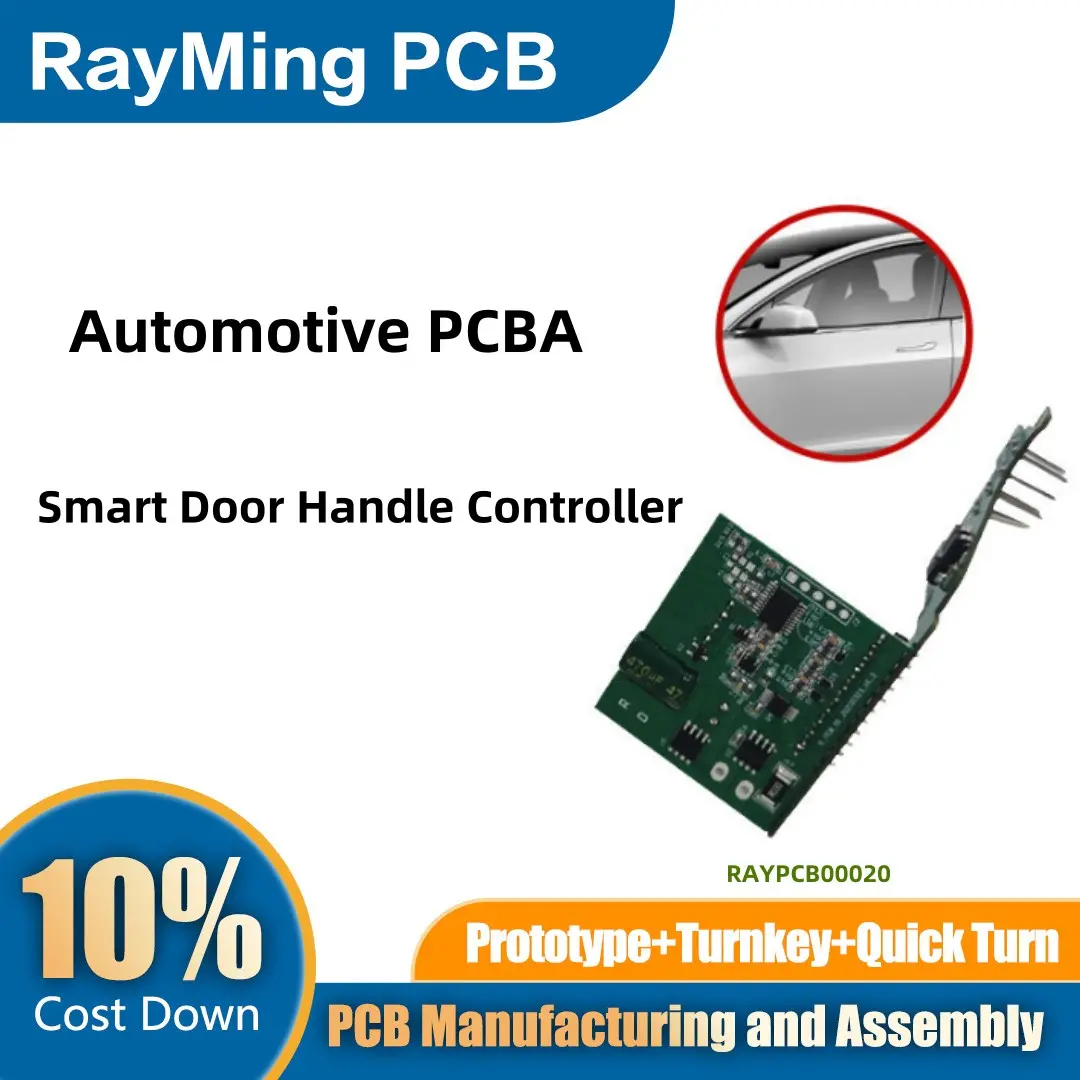
In the rapidly evolving automotive industry, smart door handle controllers have become an integral part of modern vehicles, offering enhanced security, convenience, and user experience. The heart of these systems lies in their Printed Circuit Boards (PCBs), which require meticulous design and manufacturing processes to ensure reliability, durability, and performance in demanding automotive environments.
PCB Design Considerations
1. Environmental Resilience
Automotive PCBs must withstand extreme temperatures, vibrations, and electromagnetic interference (EMI). Designers typically opt for high-grade FR-4 or polyimide substrates that offer excellent thermal stability and mechanical strength. The PCB layout should include proper grounding and shielding techniques to mitigate EMI effects.
2. Component Selection
Selecting automotive-grade components is crucial. These components are designed to operate reliably in temperature ranges from -40°C to 125°C and are tested for vibration resistance. Key components for a smart door handle controller may include:
- Microcontrollers (MCUs) with low power consumption
- Capacitive touch sensors
- Radio Frequency (RF) transceivers for keyless entry systems
- Motor drivers for latch actuation
- Power management ICs
3. Safety and Security Features
Incorporating safety features like short circuit protection, reverse polarity protection, and overvoltage protection is essential. For security, encryption modules or secure elements may be integrated to prevent unauthorized access or hacking attempts.
4. Power Management
Efficient power management is critical in automotive applications. The PCB design should include low-power modes, wake-on-event capabilities, and intelligent power distribution to minimize battery drain when the vehicle is not in use.
5. Communication Interfaces
The PCB must interface with the vehicle’s communication network, typically using protocols like CAN (Controller Area Network) or LIN (Local Interconnect Network). Proper implementation of these interfaces ensures seamless integration with the vehicle’s central locking system and other relevant subsystems.
6. Miniaturization and Space Optimization
Space is often at a premium in automotive applications. Designers must optimize component placement and routing to create a compact PCB that fits within the limited space of a door handle assembly. Advanced PCB technologies like High-Density Interconnect (HDI) may be employed to achieve the required miniaturization.
Manufacturing Process
1. PCB Fabrication
The manufacturing process begins with PCB fabrication, which involves creating the bare board according to the design specifications. For automotive applications, this often includes:
- Using high-quality, automotive-grade laminate materials
- Implementing thick copper layers for improved thermal management and current carrying capacity
- Applying specialized surface finishes like ENIG (Electroless Nickel Immersion Gold) for enhanced durability and solderability
2. Component Sourcing and Validation
Sourcing components from qualified suppliers is crucial. Each component batch should undergo incoming quality control to ensure conformity with automotive standards such as AEC-Q100 for integrated circuits.
3. Assembly
PCB assembly for automotive smart door handle controllers often employs advanced techniques:
- Automated optical inspection (AOI) at multiple stages of the assembly process
- X-ray inspection for checking solder joints of BGA and other hidden-terminal components
- Selective soldering for through-hole components to ensure high-quality joints in a mixed-technology board
4. Conformal Coating
A conformal coating is applied to protect the PCB and components from moisture, dust, and chemical contaminants. This step is crucial for ensuring the longevity of the PCB in the harsh automotive environment.
5. Testing and Validation
Rigorous testing is performed to ensure the PCB meets all functional and reliability requirements:
- In-circuit testing (ICT) to verify correct component placement and connectivity
- Functional testing to simulate real-world operation
- Environmental stress screening, including temperature cycling and vibration testing
- EMC (Electromagnetic Compatibility) testing to ensure compliance with automotive EMC standards
6. Traceability
Implementing a robust traceability system is essential in automotive manufacturing. Each PCB should be marked with a unique identifier, allowing for tracking throughout its lifecycle, from production to potential field issues.
Quality Control and Certification
Automotive PCB manufacturing must adhere to stringent quality control standards. Manufacturers typically follow guidelines set by:
- IATF 16949: The international standard for automotive quality management systems
- ISO 26262: The international standard for functional safety of electrical and electronic systems in production automobiles
Additionally, manufacturers must often comply with regional standards such as AECQ (Automotive Electronics Council Qualification) in North America or VDA (Verband der Automobilindustrie) requirements in Germany.